TL;DR: Professional water damage restoration equipment includes high-velocity air movers, low-grain refrigerant (LGR) dehumidifiers, thermal imaging cameras, and calibrated moisture meters. These tools work as a system to pull moisture out of walls, floors, and structural cavities within 3 to 5 days. A household box fan cannot do this, it moves surface air but pushes moisture deeper into building materials, setting the stage for mold growth within 24 to 48 hours.
If a restoration crew just walked into your home and started unloading equipment you have never seen before, you are probably wondering what all of it does and whether you actually need it. The short answer: yes, you need it. Each piece serves a specific function in a drying system governed by the IICRC S500 Standard for Professional Water Damage Restoration. Here is what the crew is setting up and why.
What equipment does a water damage restoration crew bring on day one?
On the first visit, a certified crew typically deploys air movers, an LGR dehumidifier, a moisture meter, and a thermal imaging camera. Together these four tools form the core drying system. Everything else, negative air machines, desiccant dehumidifiers, floor drying mats, gets added based on what the moisture readings reveal.
Here is a plain breakdown of each piece of equipment, what it does, and how long it typically runs:
| Equipment | What It Does | Typical Runtime |
|---|---|---|
| High-velocity air mover (axial fan) | Accelerates evaporation at the surface of wet materials | 3 to 5 days continuous |
| LGR dehumidifier | Captures airborne moisture and removes it from the structure | 3 to 5 days continuous |
| Moisture meter (pin or pinless) | Measures moisture content inside walls, floors, subfloor | Every 24 hours until dry |
| Thermal imaging camera | Detects hidden moisture behind walls and under flooring | Day 1 inspection; spot checks after |
| Negative air machine / air scrubber | Creates negative pressure to contain airborne particles | As needed, especially with sewage or mold |
| Desiccant dehumidifier | Handles very low humidity targets or cold environments | Specialty jobs only |
| Floor drying mat system | Dries hardwood floors from below without sanding | 3 to 7 days |
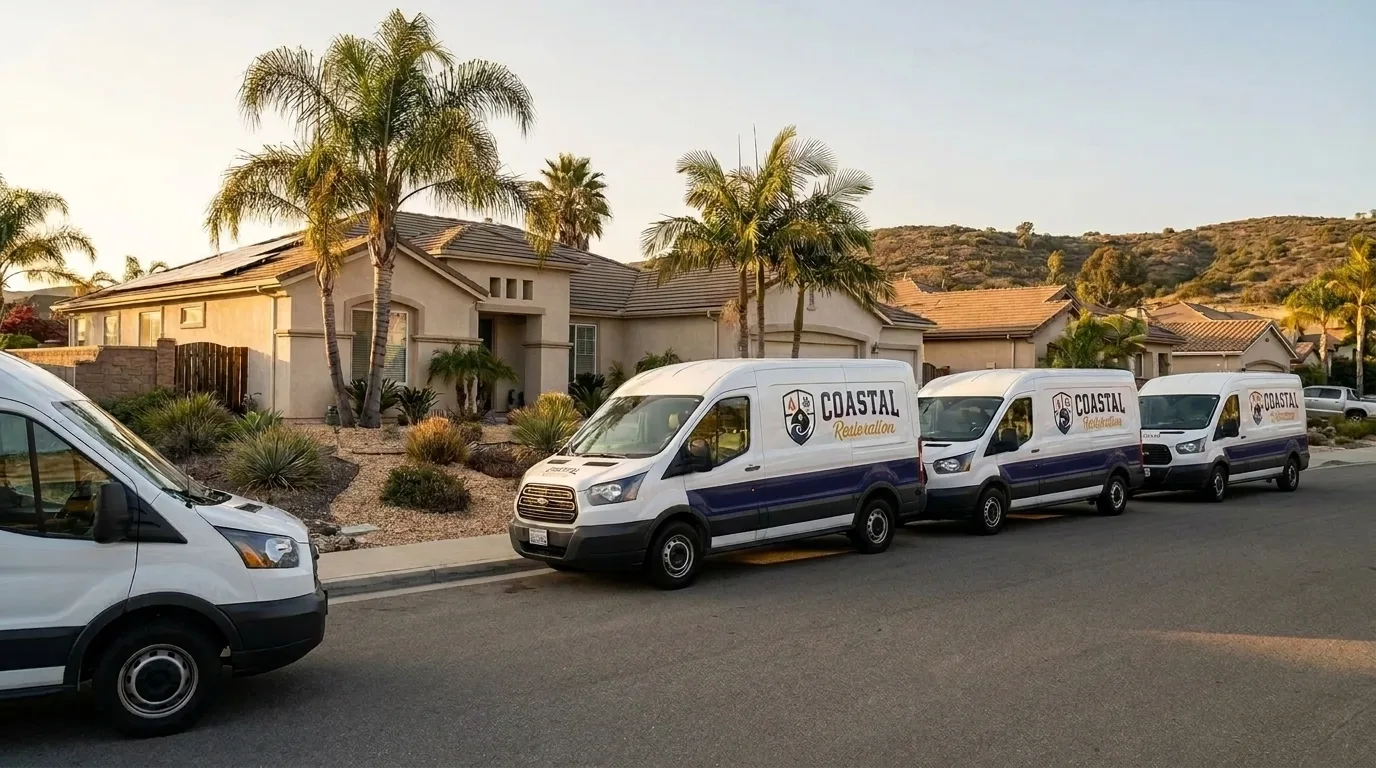
The crew from Coastal Restoration Services Inc arrives with this equipment staged and ready. Their technicians hold both WRT (Water Damage Restoration Technician) and ASD (Applied Structural Drying) certifications through the IICRC, which means the drying plan is built on measured data, not guesswork.
Why can’t you just use box fans from the hardware store?
Box fans do not remove moisture from a structure. They move air across a surface, which feels like drying, but the moisture that evaporates off the surface has to go somewhere. In a closed or semi-closed room, that moisture migrates into wall cavities, insulation, and subfloor materials where it sits.
Here is the mechanical difference:
- A high-velocity air mover (also called an axial or centrifugal fan) is positioned at a low angle against the wall, creating a vortex of air that pulls moisture off the face of wet drywall and pushes it into the room air.
- An LGR dehumidifier then captures that airborne moisture and expels it as liquid condensate through a drain hose. The air it returns to the room is drier, which allows the air movers to pull even more moisture out of the materials.
This loop, evaporate, capture, repeat, is the science behind Applied Structural Drying. A box fan only does the first half, and it does it poorly. The EPA’s guidance on mold cleanup notes that mold can begin growing on wet materials within 24 to 48 hours. Using the wrong equipment does not just slow drying, it can create a mold problem where none existed before. For more on what happens when drying is incomplete, see 7 Signs You Have Hidden Mold (and What To Do Next).
How do technicians know where the moisture actually is?
Moisture meters and thermal imaging cameras together give technicians a complete picture of where water traveled inside the structure, including places no one can see.
Moisture meters come in two types. Pin meters drive two small probes into drywall or wood and measure electrical resistance, which correlates to moisture content. Pinless meters use radio frequency to scan a wider area without penetrating the surface. Technicians use both: pinless to map the extent of the wet zone quickly, pin meters to get precise readings for the drying log.
A reading above 17% moisture content in wood or above 1% in drywall (on a relative scale) typically indicates the material needs active drying. Readings are logged every 24 hours to verify the drying system is working and to document progress for the insurance claim.
Thermal imaging cameras detect temperature differences on surfaces. Wet materials hold temperature differently than dry materials, so a thermal camera shows the outline of moisture migration behind a wall or under a floor without cutting into it. This matters because water follows gravity and wicking paths that are not obvious from the surface. A pipe that burst in the ceiling can show up as a wet zone two rooms away at floor level.
If you are curious about how this inspection process connects to mold risk, How To Test for Mold in Your Home covers the next step if moisture is found after the drying window closes.
What is Applied Structural Drying and why does it matter?
Applied Structural Drying (ASD) is the IICRC-recognized methodology for drying a structure in place rather than tearing it out. The goal is to dry materials to their pre-loss moisture content without removing them, which saves time, reduces reconstruction costs, and limits disruption to the household.
ASD technicians are trained to:
- Classify the water damage by category (Category 1 is clean water from a supply line; Category 2 is gray water from an appliance or toilet overflow; Category 3, also called black water, is sewage or floodwater) and class (how much material is affected and how deeply).
- Calculate the number and placement of air movers and dehumidifiers based on the square footage, material types, and moisture readings.
- Monitor drying daily and adjust equipment as readings improve.
- Document every reading in a drying log that becomes part of the insurance file.
Without ASD methodology, crews often over-dry (running equipment longer than needed, which costs the homeowner or insurer money) or under-dry (pulling equipment before the structure is actually dry, which leads to mold and callbacks). The certification exists precisely because drying is not intuitive, it is a physics problem that requires the right tools and the right training.
For a full breakdown of what the restoration process looks like from the first call through final repairs, What To Do in the First 24 Hours After Water Damage is a useful companion read.
How long does the equipment stay in your home?
Most residential water damage jobs reach drying goals in 3 to 5 days when the right equipment is deployed promptly. Several factors push that window longer:
- Material type: Hardwood floors and plaster walls hold moisture longer than drywall.
- Damage class: A Class 4 loss (water absorbed into dense materials like concrete or hardwood) can take 5 to 7 days or more.
- Ambient conditions: High outdoor humidity slows the dehumidifiers. Coastal Central California summers are relatively dry, which helps, but marine layer mornings can add humidity that the equipment has to fight.
- Delay before mitigation starts: Every hour the water sits before equipment arrives extends the drying timeline. A job that starts within 2 hours of the loss dries faster than one that waits 24 hours.
The crew checks readings daily and removes equipment section by section as areas reach their target moisture content. Nothing comes out early, the drying log has to confirm it.
If your claim is still open while the equipment runs, Water Damage Insurance Claim Tips: 12 Things to Do Before Anyone Tears Out Drywall covers how to document the process in a way that protects your payout.
For questions about scheduling a moisture assessment or getting a written scope of work for your loss, contact Coastal Restoration Services Inc at (805) 345-7440 or visit the water damage restoration service page.
About Coastal Restoration Services Inc
Coastal Restoration Services Inc is an IICRC-certified firm serving Santa Maria, CA and the surrounding Central Coast since its founding (license 11245226). Their technicians hold WRT and ASD certifications and handle water damage restoration, storm damage restoration, fire damage restoration, sewage cleanup, mold remediation, biohazard cleanup, contents restoration, crawl space encapsulation, emergency board-up and tarping, odor removal, post-construction cleaning, and vandalism cleanup across the region.