TL;DR: Before any drywall comes out, document everything with photos and video, call your insurer to open a claim, and get a written scope of work from a licensed restoration contractor. In California, you have the right to choose your own contractor, you are not required to use the insurance company’s preferred vendor. Mitigation (stopping further damage) must start quickly, but demolition and reconstruction should not begin until your adjuster has inspected and your scope is agreed upon in writing.
Your washing machine supply line failed overnight, or a pipe burst in the wall, and now you’re standing in two inches of water at 6 a.m. The next 48 hours will largely determine how smoothly your insurance claim goes, and how much of the bill you end up covering out of pocket. The mistakes that cost homeowners the most money almost always happen before the first piece of drywall comes off: skipping documentation, signing the wrong paperwork, or letting work begin without a written scope. Here are 12 things to do first.
What should I do immediately after water damage to protect my insurance claim?
Stop the source, document the damage, and call your insurer, in that order. Stopping the water source first prevents additional damage that your policy may not cover. Then photograph and video everything before anyone moves a single item or starts extraction.
Turn off the water supply at the shutoff valve nearest the source, or at the main if needed. (If the source is a roof leak or appliance overflow and you can’t stop it, contain it with buckets and towels.) Once the water is controlled, walk every affected room with your phone camera rolling. Capture the waterline on walls, soaked flooring, wet cabinetry, and any contents sitting in water. Timestamps on photos matter, insurers look at metadata. Then call your insurance company’s claims line to open a claim before any major work begins.
For a step-by-step guide to those first critical hours, see What To Do in the First 24 Hours After Water Damage.
How do I document water damage for an insurance claim?
Document in three layers: photos, video, and a written inventory. Photos capture the static damage; video captures the scope and context; a written inventory captures the contents and materials affected.
Here is what to capture before anything is moved or dried:
- Wide-angle room shots showing the full extent of water spread on floors and walls.
- Close-ups of the source, the failed pipe, appliance, or roof penetration.
- Waterline markings on drywall, baseboards, and cabinetry.
- Damaged contents, furniture, electronics, clothing, stored items. Photograph serial numbers on appliances if visible.
- Existing conditions, if you have any pre-loss photos (from a home listing, prior inspection, or your own files), save them. They establish baseline condition.
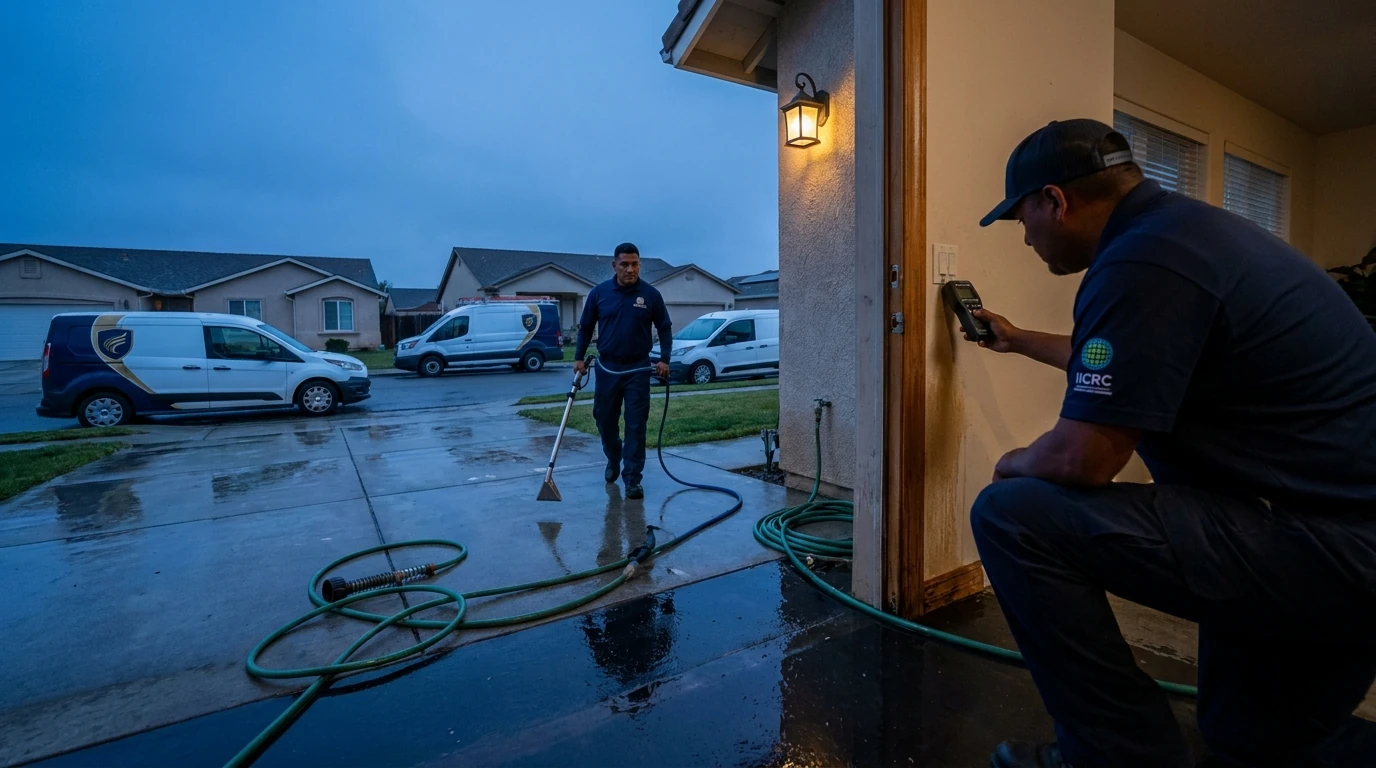
- Moisture meter readings if a restoration tech is on site, ask them to photograph the readings before extraction begins.
Keep a written list of every damaged item with estimated age and replacement cost. Your insurer will ask for this as a “contents inventory” and it is far easier to build it from photos than from memory two weeks later.
Do I have to use my insurance company’s preferred restoration contractor?
No. In California, you have the right to choose any licensed contractor to perform restoration work on your property. Your insurance company may recommend or “prefer” certain vendors, but they cannot require you to use them as a condition of your claim.
The California Department of Insurance is explicit on this point: the insurer must pay a reasonable amount for the work regardless of who performs it, as long as the contractor is properly licensed. In California, restoration contractors should hold a valid license from the Contractors State License Board (CSLB). Verify any contractor’s license at the CSLB website before signing anything. Coastal Restoration Services Inc holds CSLB license 11245226 and is an IICRC Certified Firm with WRT (Water Damage Restoration Technician) and ASD (Applied Structural Drying) certifications.
The practical implication: get at least one independent estimate from a contractor you choose. Compare it to any estimate the insurer’s preferred vendor provides. If there is a significant gap, ask the adjuster to explain the line-item differences in writing.
What is an assignment of benefits, and should I sign one?
An assignment of benefits (AOB) is a document that transfers your insurance claim rights to a third party, usually a contractor, allowing them to bill your insurer directly and pursue payment disputes on your behalf. Signing an AOB is not required and carries real risk.
Once you sign an AOB, you lose direct control over your claim. The contractor can negotiate, litigate, and settle with your insurer without your involvement, and disputes can delay your claim for months. California has seen significant AOB abuse in the property insurance market. The California Department of Insurance advises homeowners to read any AOB carefully and consult with an attorney or public adjuster before signing.
A reputable restoration company does not need an AOB to work with your insurer. They can bill the insurer directly through a standard direction-to-pay authorization, which preserves your rights as the policyholder. If a contractor pressures you to sign an AOB before work begins, that is a red flag.
What does homeowners insurance actually cover for water damage?
Most standard homeowners policies cover sudden, accidental water damage, a burst pipe, a failed appliance supply line, an ice dam backup, but exclude gradual damage, flooding from outside the home, and sewer backups (unless you have a rider).
Here is how the coverage landscape typically breaks down:
| Damage Type | Typically Covered | Typically Excluded |
|---|---|---|
| Burst pipe (sudden) | Yes | |
| Appliance supply line failure | Yes | |
| Roof leak from storm | Often (check policy) | |
| Gradual leak behind a wall | No, “long-term seepage” exclusion | |
| Flooding from outside | No, requires separate flood policy | |
| Sewer/drain backup | Only with a backup rider | |
| Mold from covered water event | Often partially |
For a deeper breakdown of what California homeowners policies cover, see Does Homeowners Insurance Cover Water Damage? A Plain-English Guide.
One important note on mold: if water damage is covered but you delay mitigation and mold develops, the insurer may argue the mold resulted from your failure to act promptly, not from the original event. That is another reason to start mold remediation quickly if moisture has been present for more than 24-48 hours. The EPA’s guidance on mold recommends beginning drying within 24-48 hours to prevent growth.
Does homeowners insurance cover additional living expenses if I can’t stay in my home?
Yes, most standard homeowners policies include Additional Living Expenses (ALE) or “loss of use” coverage. If the damage makes your home uninhabitable, ALE covers reasonable hotel, rental, and meal costs above your normal living expenses, up to your policy’s ALE limit, for the time it takes to restore the home.
To protect your ALE claim:
- Get a written statement from your adjuster or restoration contractor confirming the home is uninhabitable.
- Save every receipt for hotel, meals, laundry, and other displacement costs.
- Do not assume ALE is unlimited, check your policy’s ALE sublimit, which is often 20-30% of your dwelling coverage.
- Notify your insurer before you incur large ALE expenses (like renting a furnished apartment for three months).
What questions should I ask a water damage restoration company before hiring them?
Ask these seven questions before any contractor starts work:
- Are you IICRC certified? Look for WRT (Water Damage Restoration Technician) and ASD (Applied Structural Drying) certifications specifically. These indicate the crew is trained to the IICRC S500 standard, the industry benchmark for water damage response.
- Are you licensed with the CSLB? Ask for the license number and verify it at cslb.ca.gov.
- Will you provide a written scope of work before demolition begins? Any reputable company will. If they won’t commit to a written scope, do not let them start.
- How do you determine when the structure is dry? The answer should reference moisture content targets, psychrometric readings, and daily monitoring logs, not just “when it feels dry.”
- Will you work directly with my insurance adjuster? A good restoration company handles adjuster communication as part of the job.
- Do you require an assignment of benefits? (See above, the right answer is no.)
- What does your written warranty cover? Get any workmanship warranty in writing before signing a contract.
For more on evaluating contractors, see How To Choose a Restoration Company.
What are the most common water damage insurance claim mistakes?
The four mistakes that most often reduce or delay a payout:
1. Starting demolition before the adjuster inspects. Once drywall is gone, the adjuster cannot verify the extent of damage independently. Always get written adjuster approval, or at minimum a documented adjuster visit, before any demolition.
2. Skipping mitigation to wait for the adjuster. This is the opposite problem. Mitigation, extraction, drying, containment, must start quickly. Policies require you to prevent further damage. Waiting three days for an adjuster while wet materials continue to deteriorate can give the insurer grounds to deny the portion of damage that occurred after the original event.
3. Throwing away damaged items before they’re documented. Waterlogged flooring, ruined furniture, and damaged contents are evidence. Photograph everything before disposal. Keep samples of flooring and materials if possible.
4. Accepting a settlement before the full scope is known. Mold behind walls, subfloor damage, and structural moisture issues often aren’t visible until drying is complete. Do not sign a final release or accept a final payment until the restoration contractor confirms the full scope has been identified and documented.
What should I do if my water damage claim is denied or underpaid?
You have options. A denial or low settlement is not the end of the process.
First, request a written explanation of the denial with the specific policy language cited. Then ask your restoration contractor to provide a detailed written rebuttal, line by line, comparing the insurer’s scope to the actual documented damage. Many underpayments are resolved at this stage.
If the dispute continues, you can:
- Request an appraisal (most policies have an appraisal clause for disputed amounts).
- File a complaint with the California Department of Insurance at insurance.ca.gov.
- Hire a licensed public adjuster to represent your interests.
- Consult a property insurance attorney (most work on contingency for claim disputes).
Coastal Restoration Services Inc provides detailed written scopes and documentation packages specifically designed to support the claims process, including moisture logs, psychrometric data, and photo documentation organized for adjuster review. To request a water damage assessment, call (805) 345-7440 or visit our water damage restoration page.
About Coastal Restoration Services Inc
Coastal Restoration Services Inc is an IICRC Certified Firm serving Santa Maria, San Luis Obispo, Lompoc, and the surrounding Central Coast since their founding (CSLB license 11245226). Their certified crews hold WRT (Water Damage Restoration Technician) and ASD (Applied Structural Drying) credentials and handle water damage restoration, mold remediation, fire damage restoration, sewage cleanup, storm damage, biohazard cleanup, contents restoration, crawl space encapsulation, odor removal, emergency board-up and tarping, and vandalism cleanup across Santa Barbara and San Luis Obispo counties.