For a flooded crawl space in Santa Maria, call Coastal Restoration Services Inc at (805) 345-7440. The company answers 24/7 and is an IICRC Certified Firm with technicians trained specifically in water damage restoration and applied structural drying, the skill set a raised-foundation crawl space actually needs, not just a wet-vac and a fan.
Santa Maria’s older raised-foundation neighborhoods, especially around Orcutt and the west side of town, sit low enough that a wet winter or a cracked foundation vent well can push several inches of water under the house before anyone notices anything more than a musty smell near the hall closet. By the time the floor feels soft, the joists have usually been wet for days.
When is a flooded crawl space a restoration call, and when is it something else?
Call a water damage restoration company whenever standing water sits under the house, whether it came from a burst supply line, a failed sump pump, or rain-saturated soil working its way in through the foundation vents. Call a plumber first only if water is actively running from a pipe you can still shut off at the main. Call 911 or the utility company first if you smell gas or see exposed wiring sitting in the water.
The source of the water also determines how the crew treats it. Clean water from a burst supply line starts as Category 1 under the IICRC S500 standard, but it does not stay clean for long once it sits under a house and touches soil, insulation, and ductwork. Groundwater seeping in through the foundation during heavy rain is treated as Category 2 water from the start. A sewer or drain backup into the crawl space is Category 3 and requires full PPE and removal of any affected insulation, never just drying in place.
What happens when you call about a flooded crawl space?
The first call is mostly information gathering: your address, roughly how the water got in, and whether the crawl space already has a vapor barrier or encapsulation installed. That tells the crew what equipment to bring before they’re on site.
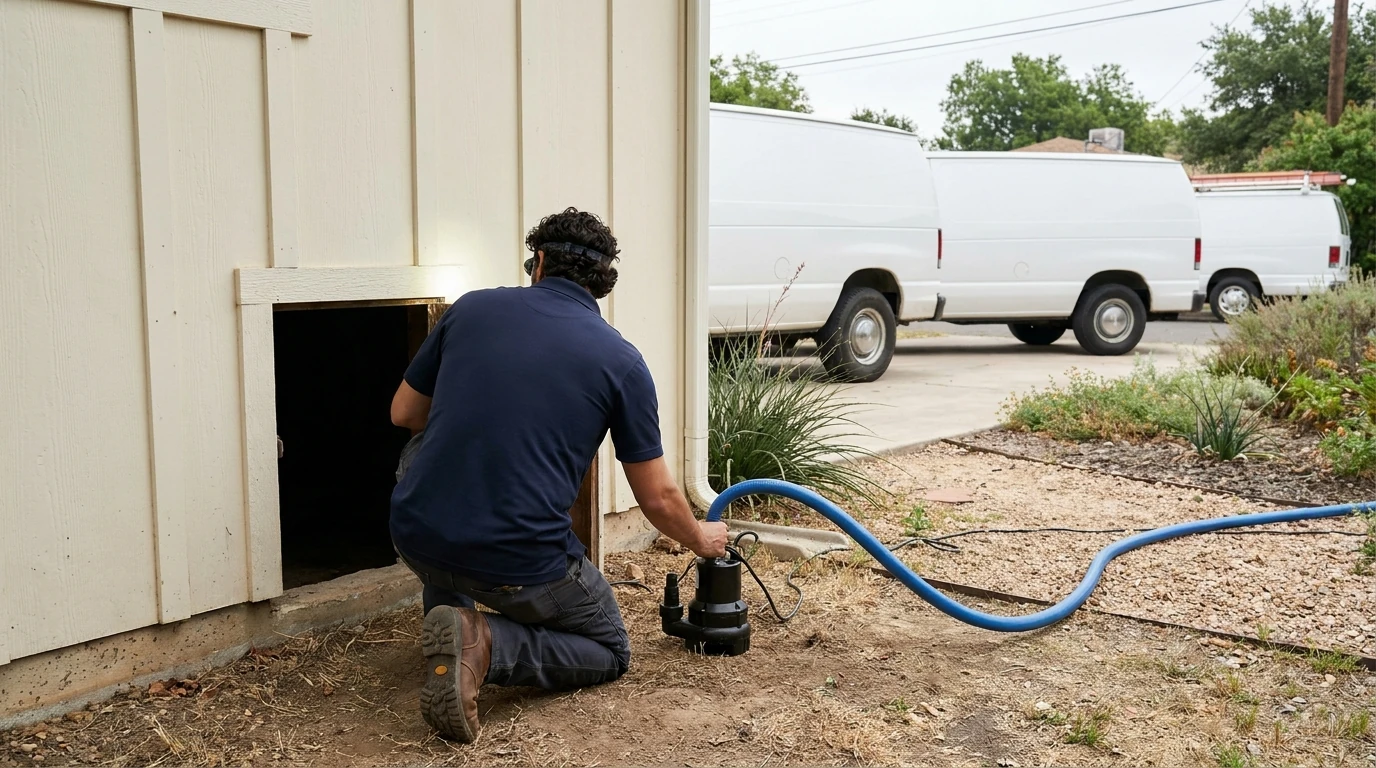
On arrival, a technician opens the crawl space access and checks the water category, how far it has spread, and how saturated the joists, subfloor, and any insulation batts have become. Standing water comes out first, usually with a submersible or trash pump rather than a shop vac, since crawl spaces often hold more water than they look like they do from the access hatch.
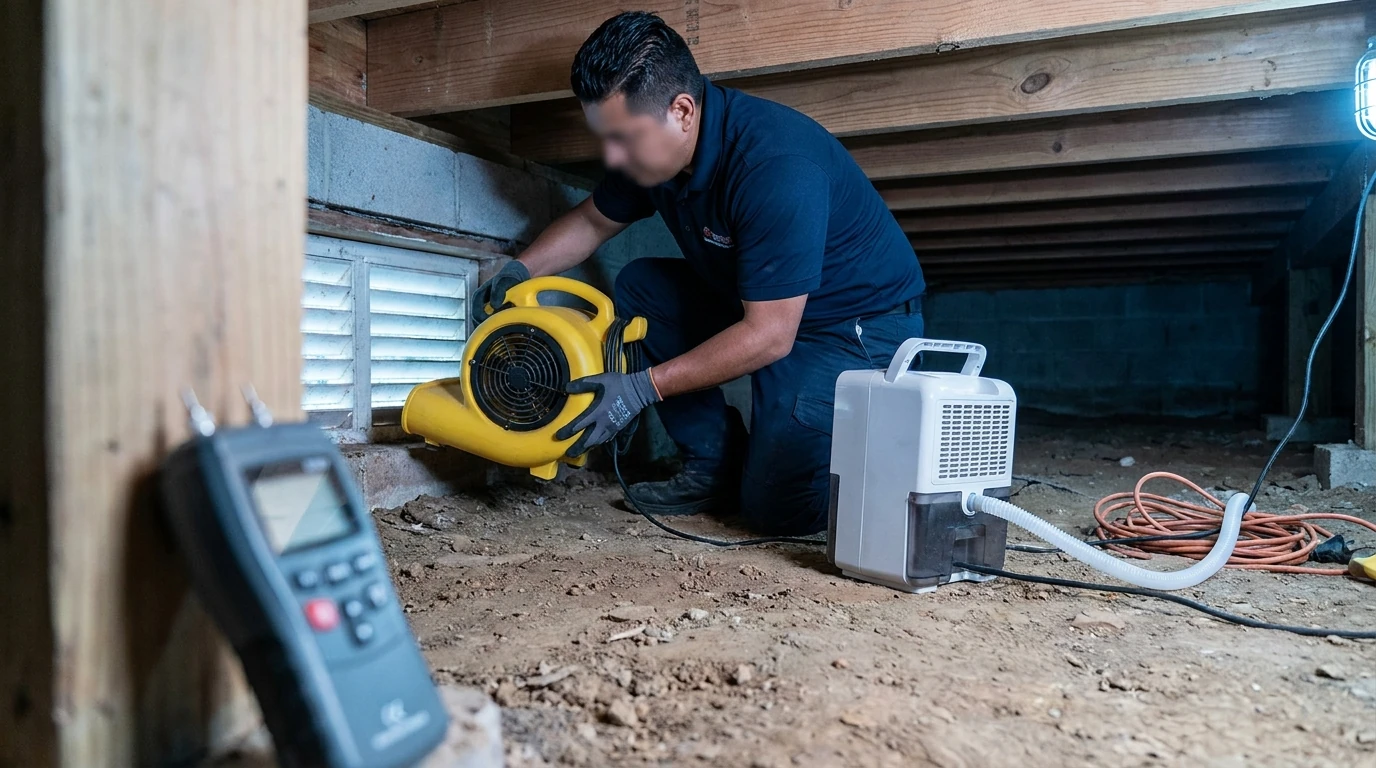
Once the water is out, the drying phase starts: air movers positioned to push air across the subfloor and joists, a dehumidifier sized to the space, and any waterlogged fiberglass batt insulation pulled and bagged rather than dried, since wet insulation rarely dries evenly and tends to hold moisture against the subfloor. The crew checks moisture content on the joists and subfloor with a meter over the following days and keeps the equipment running until those readings hit the dry standard, not until the space just looks dry.
How fast can mold start growing in a flooded crawl space?
Mold can begin growing on wet wood and insulation within 24 to 48 hours, according to the EPA, and a crawl space is about the worst place for that clock to start. It is dark, humid, and easy to forget about once the surface water is gone.
A vented crawl space under a Santa Maria home also tends to run more humid than the living space above it for most of the year, which is exactly why mold shows up on joists and subfloor sheathing even after a drying job that looked successful at the time. If you’re already seeing a musty smell or discoloration on framing months after a flood, that’s worth a mold inspection rather than assuming it will air itself out.
When does crawl space encapsulation make sense after a flood?
Encapsulation is worth discussing once a crawl space has flooded more than once, or once drying reveals that the vented design keeps letting ground moisture back in no matter how thoroughly it dried this time. A vented crawl space pulls in outside humidity by design; sealing it off changes that equation.
Crawl space encapsulation typically means sealing the foundation vents, installing a heavy vapor barrier across the ground and up the walls, and in many cases adding a dedicated dehumidifier so the space stays dry year-round instead of drying out only after someone intervenes. It is not the first conversation after a flood, it is usually the second one, once the current water is out and the drying numbers are in. For what that upgrade runs in this area, the crawl space encapsulation cost guide for Santa Maria breaks down the factors that move the price.
Most homeowners insurance policies cover sudden water damage, like a burst pipe, but not gradual seepage or flood water from outside the home; the guide to homeowners insurance and water damage walks through what usually gets paid and what to document before anyone starts pulling out insulation.
If water is sitting under your house right now, the next useful step is getting someone under there with a pump and a moisture meter before you decide anything about encapsulation. Call Coastal Restoration Services Inc at (805) 345-7440 or request an assessment online and a technician will walk the crawl space with you.
About Coastal Restoration Services Inc
Coastal Restoration Services Inc is an IICRC Certified Firm (license #11245226) serving Santa Maria and the surrounding Central Coast, with technicians holding WRT and ASD certifications for water extraction and structural drying. The company is rated 5.0 on Google across 29 reviews and answers calls 24/7. Its crews handle water damage restoration, crawl space encapsulation, and mold remediation throughout the region, written by Tony Mendez.