Large Loss and Catastrophic Response in Santa Maria
Large loss and catastrophic response in Santa Maria and surrounding areas. IICRC-certified, insurance billing accepted. Call (805) 345-7440.
Large Loss and Catastrophic Response
When a fire guts a processing facility, a pipe failure floods three floors of a hotel, or a winter storm takes the roof off a warehouse, the math changes. A single-room water loss and a 40,000-square-foot commercial loss are not the same job scaled up, they’re a different kind of problem: multiple structures, multiple insurance stakeholders, equipment needs measured in truckloads instead of units, and a business or property owner losing revenue every day the building stays offline. Coastal Restoration Services Inc handles that category of loss for commercial property managers, general contractors, and large-loss adjusters across the Central Coast.
What large loss and catastrophic response actually involves
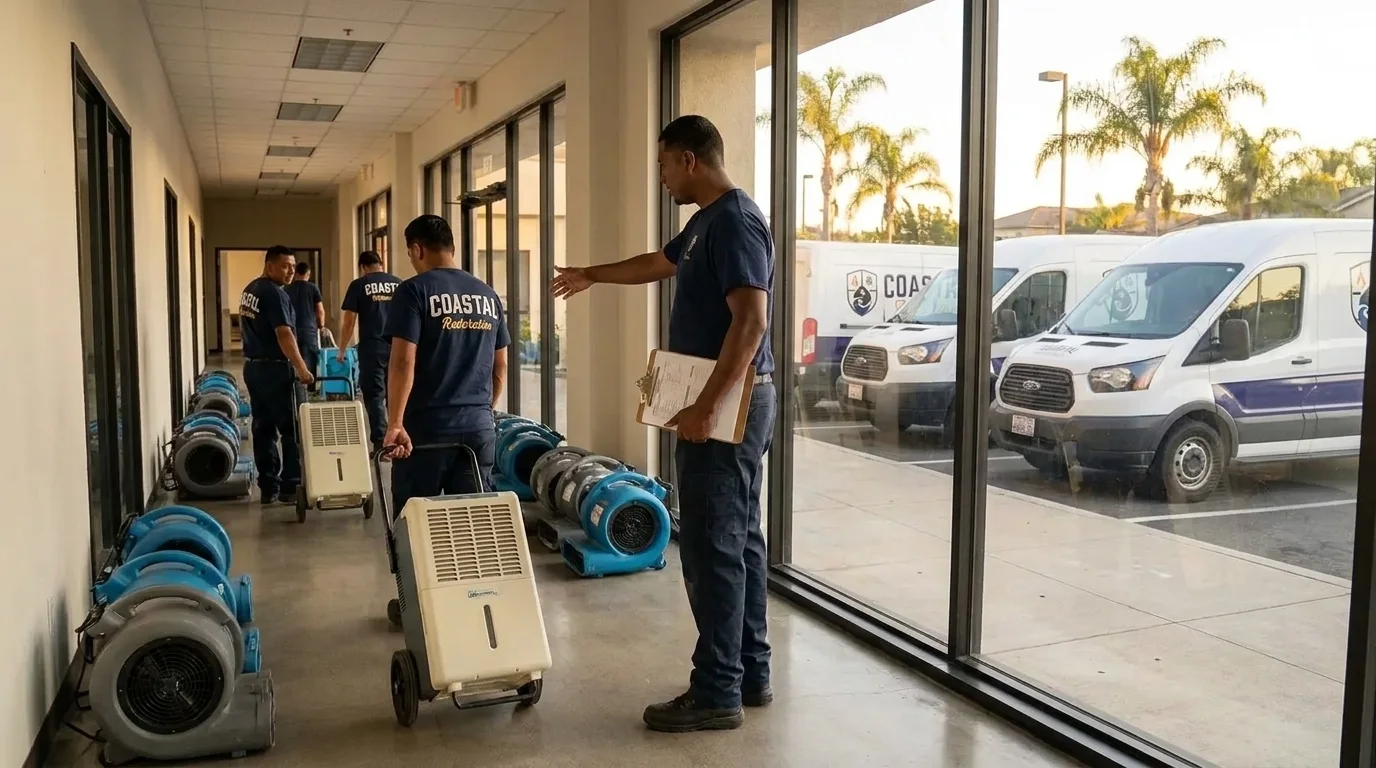
A large loss is typically defined by scope, not just dollar value: multi-building campuses, agricultural and food processing facilities, hospitality properties, multi-family complexes, or any single loss that exceeds what a standard residential crew can mobilize for in a reasonable timeframe. The work still includes extraction, structural drying, demolition, and reconstruction, but it runs in parallel across zones instead of in sequence. Equipment deployment is planned around electrical load limits and building systems, not just square footage. Documentation has to satisfy large-loss adjusters and third-party administrators who expect daily moisture logs, drying curves, and photo-based progress reports, not a single summary at the end.
Timelines vary enormously depending on the structure and damage class, but catastrophic jobs are measured in weeks and phases rather than days. A warehouse fire might need two weeks of mitigation before reconstruction scoping even begins. A multi-building flood might have some zones back in service while others are still drying.
Our process
- Rapid site triage and structural assessment. Before equipment moves in, the loss gets mapped by zone, affected materials, structural risk, and business-continuity priority, so the areas that need to come back online first get staffed first.
- Multi-crew mobilization. Extraction, drying, and demolition crews deploy simultaneously across zones rather than working the building room by room, which is what keeps a large loss from stretching into months.
- Direct coordination with large-loss adjusters and TPAs. Scope, pricing, and daily progress are documented in formats adjusters already use (Xactimate estimates, moisture logs, photo and Matterport walkthroughs) so claim review doesn’t stall the restoration timeline.
- Phased drying, demolition, and reconstruction. Zones are returned to the owner or contractor on a rolling basis as they clear moisture and inspection benchmarks, instead of holding the whole property hostage to the slowest-drying section.
- Final documentation and sign-off. Clearance readings, scope completion records, and reconstruction punch lists are compiled for the adjuster, the property owner, and, where applicable, the general contractor taking over finish work.
What separates a good large loss response from a bad one
The most common failure on catastrophic jobs isn’t technical, it’s logistical: undersized crews trying to run a large loss like a residential one, equipment arriving in waves instead of all at once, and documentation that lags behind the work until an adjuster asks for records that were never kept. That gap is what turns a six-week job into a four-month one.
Adjusters reviewing large losses look for a few specific things: daily moisture tracking that shows drying trend lines (not just a pass/fail reading), demolition that’s scoped and photographed before it happens, and a clear chain of custody on anything removed from the structure. They also look for realistic phasing. A plan that claims the whole property will be dry and reconstructed in two weeks when the structure size says otherwise tends to get flagged, and rightly so.
What does large loss and catastrophic response cost?
Large loss pricing is driven by square footage, number of affected zones, category of water or combustion involved, and how much of the structure requires demolition versus drying in place. Every loss gets a written scope before work begins, because a warehouse flood and a hotel fire of similar size can still differ by a factor of three or more depending on materials and systems involved. Most commercial property insurance covers large loss mitigation and reconstruction, though policies vary on business interruption coverage and code-upgrade allowances, which is worth confirming with the adjuster early.
| Scenario | Typical range |
|---|---|
| Single-floor commercial water loss, clean source | $15,000 - $45,000 |
| Multi-floor hotel or multi-family flood | $75,000 - $300,000 |
| Agricultural or processing facility fire | $150,000 - $750,000+ |
| Warehouse structural fire with roof loss | $250,000 - $1,000,000+ |
| Multi-building storm damage campus | $200,000 - $900,000+ |
Seasonal & regional considerations
Santa Maria’s economy runs on agriculture and hospitality, and both sectors carry catastrophic-loss exposure that looks different from a typical residential claim. Cold-storage and processing facilities along the 101 corridor have refrigeration and electrical systems that complicate drying plans, and a fire or flood there often means coordinating with food-safety requirements, not just structural drying. Winter atmospheric river systems off the Central Coast can produce concentrated rainfall events that overwhelm drainage on larger commercial roofs and parking structures, and the resulting water intrusion frequently affects multiple tenants or buildings at once. Wildfire smoke drift from inland ranges can also settle into large HVAC systems across a commercial campus, which turns a smoke event into a multi-building cleaning and remediation project rather than a single-unit job.
Service area
Coastal Restoration Services Inc responds to large loss and catastrophic events throughout Santa Maria and the surrounding Central Coast, including Santa Barbara County’s agricultural and coastal communities. For jobs spanning multiple properties or jurisdictions, scope and permitting coordination are handled as part of the project plan, not left to the property owner to untangle.
If you’re managing a property with damage that’s outgrown a standard restoration crew, call (805) 345-7440 to get a large loss assessment started.
Frequently Asked Questions
What qualifies as a large loss versus a standard restoration job?
Does commercial property insurance cover large loss restoration?
How is a multi-building or multi-zone loss managed without shutting down the whole property?
What documentation do large loss adjusters typically require during the job?
How long does a catastrophic loss typically take from mitigation to reconstruction?
Looking for the best large loss and catastrophic response company in Santa Maria?
Coastal Restoration Services Inc provides licensed and insured large loss and catastrophic response in Santa Maria, CA and the surrounding area. Customers rate us 5.0 out of 5 stars across 29 Google reviews. We answer calls 24/7 — call (805) 345-7440 for immediate help.
Need Large Loss and Catastrophic Response now?
We respond 24/7 across Santa Maria and surrounding CA cities.
Related Coverage
- Our Restoration Services
- Contact Coastal Restoration Services Inc
- Restoration Services in Arroyo Grande
- Restoration Services in Atascadero
- Restoration Services in Avila Beach
- Restoration Services in Ballard
- Restoration Services in Blacklake
- Restoration Services in Buellton
- Restoration Services in Callender
- Restoration Services in Cambria
- Restoration Services in Edna
- Restoration Services in El Paso de Robles
- Restoration Services in Grover Beach
- Restoration Services in Guadalupe