
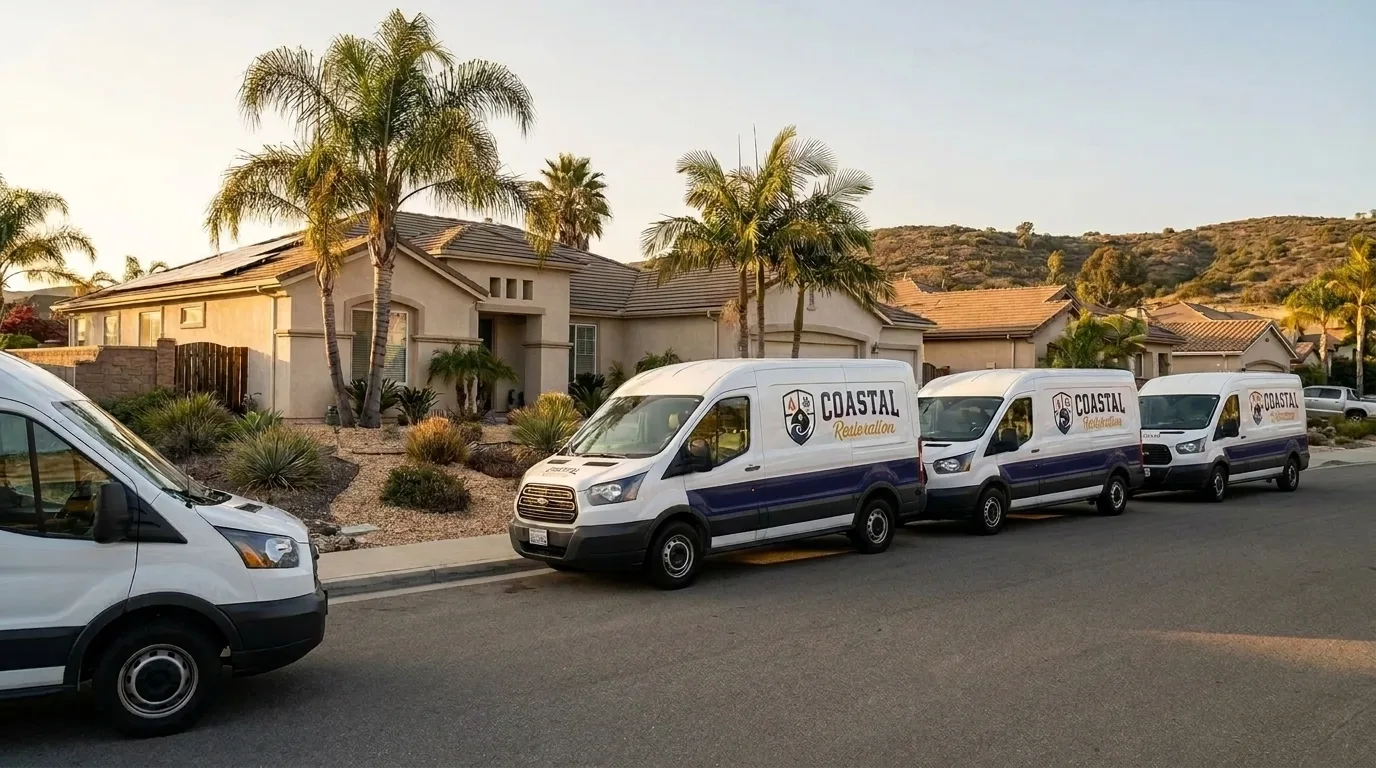
Contents Restoration & Storage in Santa Maria
Contents restoration & storage in Santa Maria and surrounding areas. IICRC-certified, insurance billing accepted. Call (805) 345-7440.
When a water line bursts or a fire tears through a kitchen, the structure gets the headlines, but it’s the contents that carry the real weight of a loss. Furniture soaked in Category 2 water begins to delaminate within 48 hours. Smoke odor embeds into upholstery fibers at a molecular level that surface wiping cannot touch. Contents restoration is the work of pulling those objects back from the edge, using chemistry, controlled environments, and specialized equipment, before the window for recovery closes permanently.
What Contents Restoration & Storage actually involves
Contents restoration is not cleaning. It is a structured process of inventorying, evaluating, treating, and storing the personal property inside a damaged structure, separate from any structural work happening to the building itself.
A trained technician walks the loss with a room-by-room inventory, photographing and cataloging every item before anything is moved. Objects are sorted into three categories: restorable, non-restorable, and questionable. That third category is where experience matters most. A piece that looks ruined, a wood-framed oil painting, a leather-bound book, a wool rug, may be fully recoverable with the right treatment. A piece that looks fine, an upholstered chair with no visible soot, may be carrying embedded odor compounds that will off-gas for months if it goes back into the home untreated.
Restoration methods vary by material and contamination type. Ultrasonic cleaning tanks use high-frequency sound waves to remove soot, mold spores, and residue from hard surfaces without abrasion. Ozone chambers and hydroxyl generators neutralize odor compounds in soft goods. Freeze-drying chambers can stabilize waterlogged documents and photographs that would otherwise be lost within days. Textile cleaning follows fiber-specific protocols because what works on synthetic carpet destroys natural wool.
Once treated, items move into a climate-controlled storage facility, where temperature and humidity are held steady until the structure is ready to receive them. That controlled environment matters: returning restored contents to a building that still has elevated moisture or residual smoke odor simply re-contaminates them.
Our process
-
Pack-out inventory and condition documentation. Every item is photographed in place, assigned a condition grade, and logged before it leaves the structure. This record protects both the homeowner and the insurance carrier and establishes a clear baseline for restoration success.
-
Triage and category sorting. Items are separated into restorable, non-restorable, and needs-evaluation groups. Non-restorable items are documented for the adjuster’s depreciation schedule. Questionable items go to the lab before any decision is made.
-
Material-appropriate cleaning and treatment. Hard goods, electronics, textiles, documents, and artwork each follow a distinct treatment protocol. Soot type matters here: dry, powdery soot from natural materials behaves differently than the oily, sticky residue left by synthetic combustion, and using the wrong cleaning chemistry on the wrong soot type drives contamination deeper into the substrate.
-
Odor neutralization. Structural cleaning alone does not eliminate smoke or microbial odor from contents. Treated items move through ozone or hydroxyl cycles calibrated to the material type and contamination load. Soft goods that skip this step are the most common source of recurring odor complaints after a restoration.
-
Climate-controlled storage and coordinated return. Items are stored in a secured, climate-controlled facility until the structure passes clearance. Return delivery is scheduled and coordinated with the structural restoration timeline so contents go back into a clean, dry, fully remediated space.
What separates a good contents response from a bad one
The most common failure in contents restoration is speed without documentation. Moving items quickly to protect them from further damage is correct. Moving them without a thorough pre-pack inventory creates disputes with adjusters, gaps in the insurance claim, and no way to prove pre-loss condition for high-value items.
A second common failure is treating all soot the same way. Protein soot, produced by burning food or organic material, is nearly invisible but extraordinarily penetrating. It requires enzymatic or alkaline cleaners and extended contact time. Synthetic soot from burning plastics or petroleum products is oily and smears if wiped dry. Applying a dry-cleaning sponge to synthetic soot spreads it; applying a wet alkaline cleaner to protein soot without the right dwell time leaves the odor source intact. Adjusters reviewing a contents claim will look for itemized treatment records that show the method matched the contamination type.
A third gap is storage environment. Items moved to an unconditioned garage or warehouse during restoration can develop secondary mold growth within days if ambient humidity is not controlled. A legitimate contents restoration operation maintains documented temperature and humidity logs for stored items throughout the hold period.
What does Contents Restoration & Storage cost?
Typical costs for contents restoration depend on volume, contamination type, and the mix of materials involved. Most homeowners find that contents restoration runs anywhere from a few hundred dollars for a single room of lightly affected hard goods to well over ten thousand dollars for a whole-house pack-out with extensive soft goods and odor treatment. The table below reflects typical industry ranges.
| Scenario | Typical range |
|---|---|
| Single room, hard goods only, water damage | $800 - $2,500 |
| Single room with soft goods and odor treatment | $1,500 - $4,000 |
| Whole-house pack-out, water or fire loss | $4,000 - $15,000+ |
| Document and photo recovery (freeze-drying) | $500 - $3,000 |
| Extended climate-controlled storage (per month) | $200 - $600 |
| Electronics evaluation and cleaning | $150 - $800 per item |
Every loss is different, and Coastal Restoration Services Inc provides a written scope of work before any restoration begins. Homeowners insurance typically covers contents restoration when the loss is caused by a covered peril, and coverage limits are set by the personal property section of your policy.
Seasonal and regional considerations
Santa Maria’s coastal marine layer keeps indoor humidity elevated through much of the year, which shortens the window between a water loss and secondary mold colonization on soft goods. Items that might stay stable for 72 hours in a drier inland climate can show surface mold growth in 48 hours or less when ambient humidity is already high. That compressed timeline makes rapid pack-out and immediate transfer to a controlled storage environment more critical here than in drier regions. During the dry-season fire months, the fine particulate soot produced by wildland and structure fires in the Santa Barbara County area tends to travel farther and penetrate more deeply into fabrics and HVAC-distributed contents than typical residential fire soot.
Service area
Coastal Restoration Services Inc is based in Santa Maria and provides contents restoration and storage services throughout the surrounding region, including Lompoc, Orcutt, Guadalupe, Arroyo Grande, Pismo Beach, and San Luis Obispo. Individual city service pages link back to this page for full process and technical detail.
If your home or property has suffered a loss and you are watching the clock on your contents, call (805) 345-7440 to schedule a pack-out assessment and get your belongings into a controlled environment before the restoration window closes.
Frequently Asked Questions
Does homeowners insurance cover contents restoration and storage?
How do you decide what can be restored versus what needs to be replaced?
What happens to my belongings while they are in storage?
Can water-damaged photographs and documents actually be saved?
Why does smoke odor come back in furniture even after it has been cleaned?
Looking for the best contents restoration & storage company in Santa Maria?
Coastal Restoration Services Inc provides licensed and insured contents restoration & storage in Santa Maria, CA and the surrounding area. Customers rate us 5.0 out of 5 stars across 29 Google reviews. We answer calls 24/7 — call (805) 345-7440 for immediate help.
Need Contents Restoration & Storage now?
We respond 24/7 across Santa Maria and surrounding CA cities.
Related Coverage
- Our Restoration Services
- Contact Coastal Restoration Services Inc
- Contents Restoration & Storage in Arroyo Grande
- Contents Restoration & Storage in Atascadero
- Contents Restoration & Storage in Avila Beach
- Contents Restoration & Storage in Ballard
- Contents Restoration & Storage in Blacklake
- Contents Restoration & Storage in Buellton
- Contents Restoration & Storage in Callender
- Contents Restoration & Storage in Cambria
- Contents Restoration & Storage in Edna
- Contents Restoration & Storage in El Paso de Robles
- Contents Restoration & Storage in Grover Beach
- Contents Restoration & Storage in Guadalupe