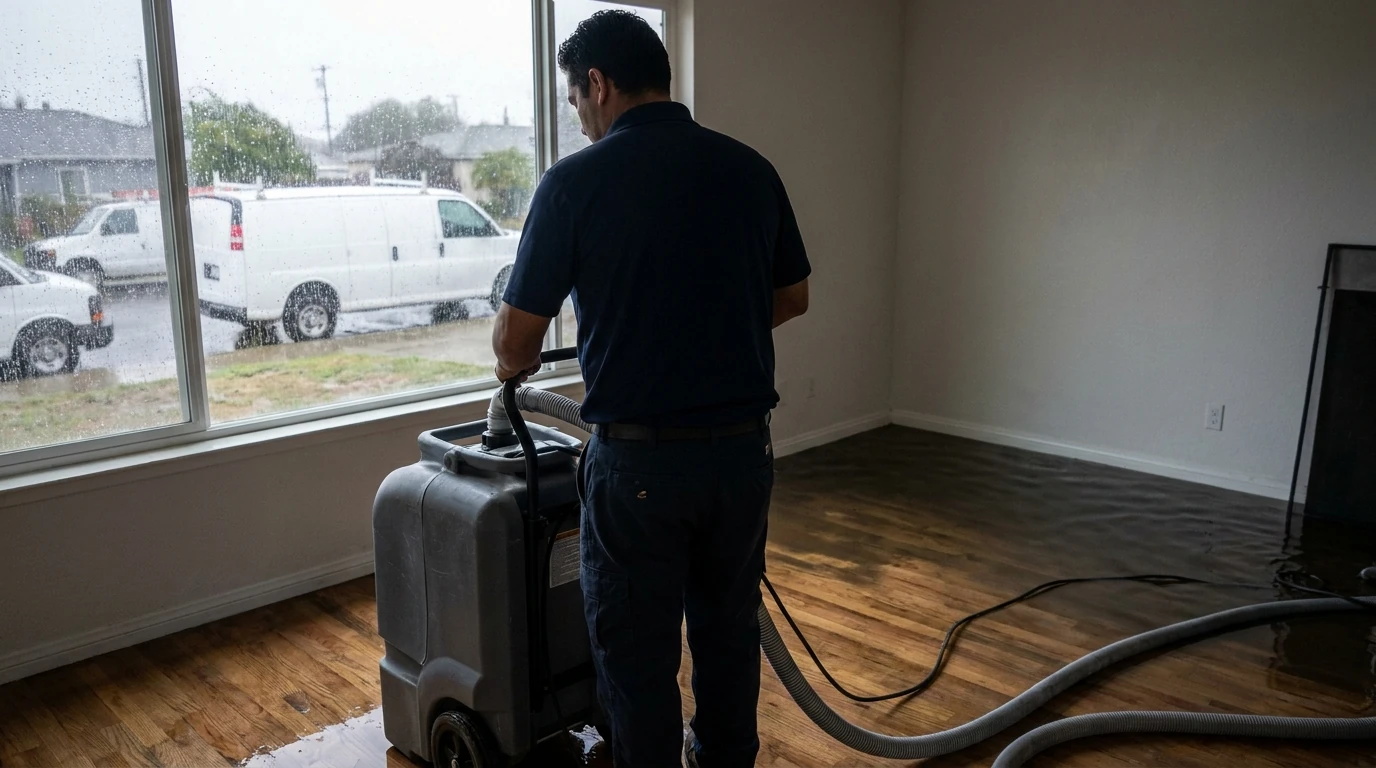
If storm water is already coming into your Santa Maria home, call Coastal Restoration Services Inc at (805) 345-7440. The line is answered 24/7, CRS is an IICRC Certified Firm, and the crew carries both WRT (Water Damage Restoration Technician) and ASD (Applied Structural Drying) certifications, so extraction and drying can start the same call.
Atmospheric river storms push heavy, sustained rain through the Central Coast most winters, and Santa Maria’s lower-lying streets near the Santa Maria River levee are usually the first to see water back up past the curb. If that’s what’s happening at your place right now, the rest of this page covers who handles what, and what to do in the next few minutes while help is on the way.
When is storm flooding a restoration-company call, and when is it something else first?
Storm flooding is a restoration-company call the moment water is inside the structure, whether it’s seeping under a door, rising through a slab crack, or backing up through a floor drain. That’s the point where Coastal Restoration Services Inc needs to start extraction before standing water soaks further into drywall, insulation, and subflooring.
A few situations need a different first call:
- Downed power lines in or near standing water, a burning smell, or a submerged electrical panel. Call 911 and your utility provider first. Don’t enter the water until power is confirmed off.
- Water still actively flowing from a burst supply line or water heater inside the house, separate from storm water coming in from outside. Shut the main valve if you can safely reach it; that’s a plumbing fix alongside the drying work.
- Your insurance company comes after mitigation starts, not before. California policies expect homeowners to limit further damage, and CRS documents the loss with photos and moisture readings that support the claim once you do call it in.
If none of those apply and water is simply in the house, CRS is the first call.
What are the different ways storm water actually gets into a Santa Maria home?
Not all storm water is the same contamination level, and that matters for how it’s cleaned up. The IICRC S500 standard sorts water intrusion into categories based on how contaminated it is.
Wind-driven rain through a roof leak or window often starts as Category 1 (clean) but degrades quickly as it travels through attic insulation, ceiling material, and wall cavities, and storm-driven rain in a hard atmospheric river event is usually treated as Category 3 from the start. If a leaking roof is your situation specifically, our roof leaks in heavy rain guide covers that scenario in more depth.
Surface water flowing in from outside, street flooding that overtops a curb or comes in under a garage door or exterior door, is Category 3 (black water). It’s picked up oil, debris, and whatever else is on the pavement before it reaches your floor.
Groundwater and hydrostatic pressure pushing up through slab cracks or crawl space vents after days of saturated soil is Category 2 (gray water), common in low-lying parts of town after a sustained storm, not as contaminated as sewage or surface runoff but still requires antimicrobial treatment and isn’t safe to treat as clean water.
A sewer or storm drain backup during heavy rain, when the municipal system is overwhelmed and water pushes back up through a floor drain or toilet, is always Category 3, regardless of what started it.
The category determines whether materials get dried in place or removed, and whether PPE is required during the work.
What happens when you call CRS for storm flooding?
The first call is a short triage conversation: where the water is coming from, roughly how much of the structure is affected, whether power and gas are safe, and whether anyone’s had skin contact with the water. Have your address and a rough sense of which rooms are affected ready; it speeds up dispatch.
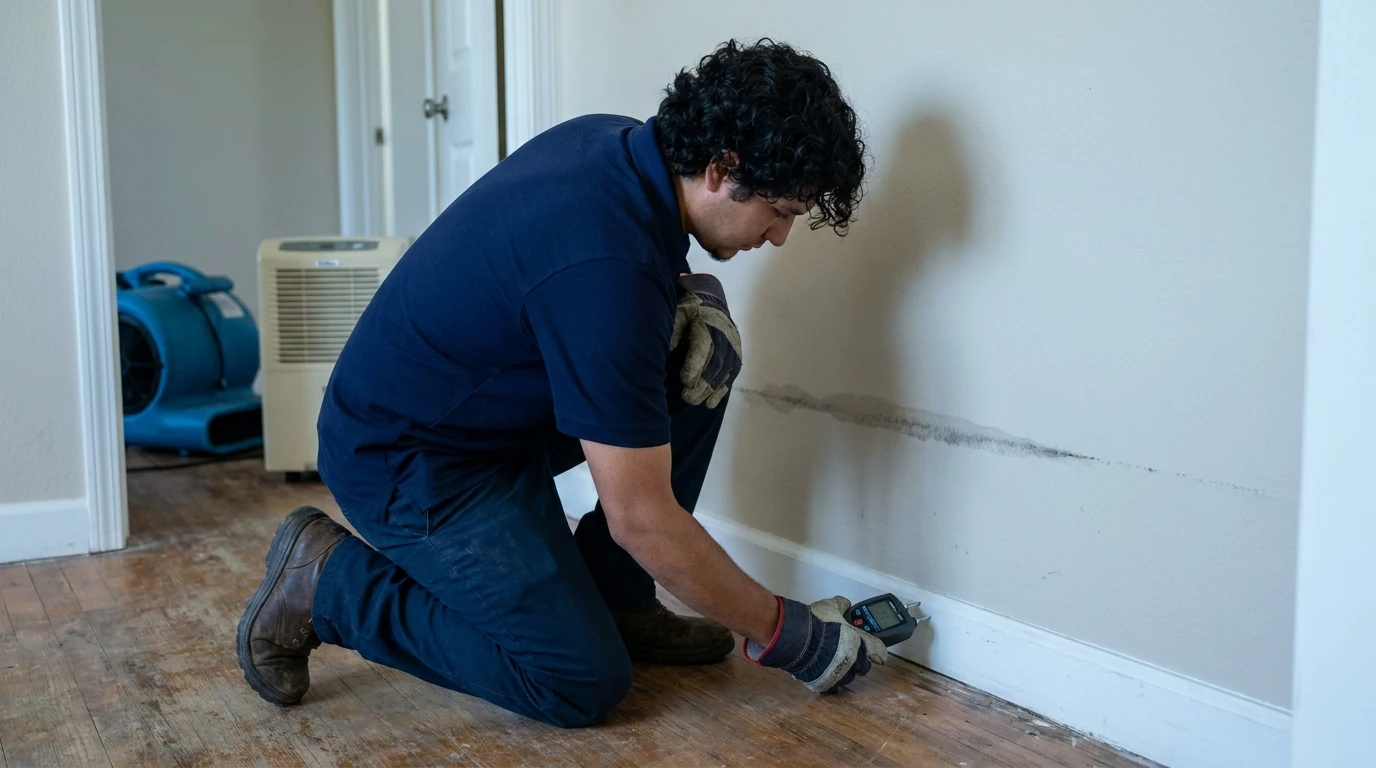
On arrival, the crew shuts off standing hazards first, then starts extraction with truck-mounted or portable pumps depending on the volume of water. They set up moisture mapping across walls and flooring to find where water has traveled beyond what’s visible, place air movers and dehumidifiers, and document everything with photos for the insurance file. If the water category calls for it, affected porous materials like carpet pad or baseboard are removed rather than dried, since they can’t be fully disinfected in place.
What should you do before the crew gets there?
The most useful thing you can do while you wait is stay out of the water and stop the damage from spreading, not start cleanup yourself. If it’s safe to reach, shut off power to any affected rooms at the breaker rather than at a wall switch.
Move anything you can lift, furniture, electronics, boxes off the floor and away from the waterline. Don’t wade through standing storm water barefoot or with open cuts; Category 2 and 3 water can carry bacteria and chemical runoff. Take photos of the water level and affected rooms now, before anything is moved, for your own insurance file. Our general guide on who to call for water damage in Santa Maria covers the non-storm version of this triage if a slower leak is part of what’s going on.
Whether it clears on its own schedule or needs a crew out tonight, the sooner extraction starts, the less drywall, flooring, and insulation has to be replaced instead of dried.
About Coastal Restoration Services Inc
Coastal Restoration Services Inc is an IICRC Certified Firm based in Santa Maria, CA (CA license #11245226), with technicians holding WRT and ASD certifications. The company answers the phone 24/7 and holds a 5.0 Google rating across 29 reviews from homeowners across Santa Maria, Orcutt, and the surrounding Central Coast. This post was prepared with input from Tony Mendez and the CRS team, who respond to flood and storm damage calls throughout the service area.
Call Coastal Restoration Services Inc at (805) 345-7440 or request help online if storm water is affecting your home right now.