TL;DR: In Santa Maria, CA, fire damage restoration typically costs $2,500 to $8,500 for a contained single-room fire and $20,000 to $100,000 or more for a multi-room or whole-structure loss. The biggest cost drivers are how far smoke traveled through the HVAC system, whether suppression water caused secondary damage, and how much of the structure needs rebuilding versus cleaning. Most homeowners insurance policies cover fire damage restoration; a written scope from a licensed restoration company is what gets that claim paid correctly.
If you’re standing in a kitchen with a scorched cabinet and soot creeping up the wall after a grease fire, or you’re staring at a bedroom where a space heater caught the carpet, the question on your mind isn’t abstract: what is this actually going to cost, and will the insurance company pay for it? The honest answer depends on three things: how big the fire got before it was out, what kind of smoke it produced, and whether the fire department’s hoses did as much damage as the flames did.
How much does fire damage restoration cost in Santa Maria, CA?
Most Santa Maria homeowners pay somewhere between $2,500 for a contained, one-room fire and $100,000 or more for a structure fire that destroys multiple rooms. The number moves fast because fire damage is really two separate jobs: cleaning and deodorizing what survived, and rebuilding what didn’t.
| Scenario | Typical cost range |
|---|---|
| Minor kitchen or appliance fire, smoke confined to one room | $2,500 - $8,500 |
| Single-room fire with charred structure, no major suppression water | $8,000 - $20,000 |
| Multi-room fire with smoke infiltration through ductwork | $20,000 - $45,000 |
| Whole-structure fire with significant framing and roof loss | $45,000 - $100,000+ |
| Contents cleaning and pack-out, per room | $500 - $2,500 |
| Standalone odor removal (ozone or hydroxyl treatment) | $300 - $1,500 |
These are typical industry ranges, not a quote. Every fire is different, and a written scope of work, done before anything is torn out, is what protects both the insurance claim and the homeowner’s wallet.
What factors drive fire damage restoration costs?
The price moves on four variables: smoke type, water from suppression, square footage affected, and code upgrades required during rebuild.
Smoke type matters more than most people expect. A grease fire produces a different residue than a fire that burned synthetic carpet or foam furniture, and protein-based smoke (from a kitchen fire) bonds to surfaces differently than the dry, powdery soot from a wood-frame fire. Each type calls for a different cleaning agent and a different number of passes, which changes labor hours fast.
Suppression water is the hidden cost most people don’t budget for. Fire crews use thousands of gallons of water to knock down a structure fire, and that water goes everywhere: down walls, under flooring, into the subfloor. If it isn’t extracted and dried within 24 to 48 hours, it becomes a second, separate water damage job on top of the fire cleanup (see our guide on water damage restoration costs in CA for how that pricing works on its own).
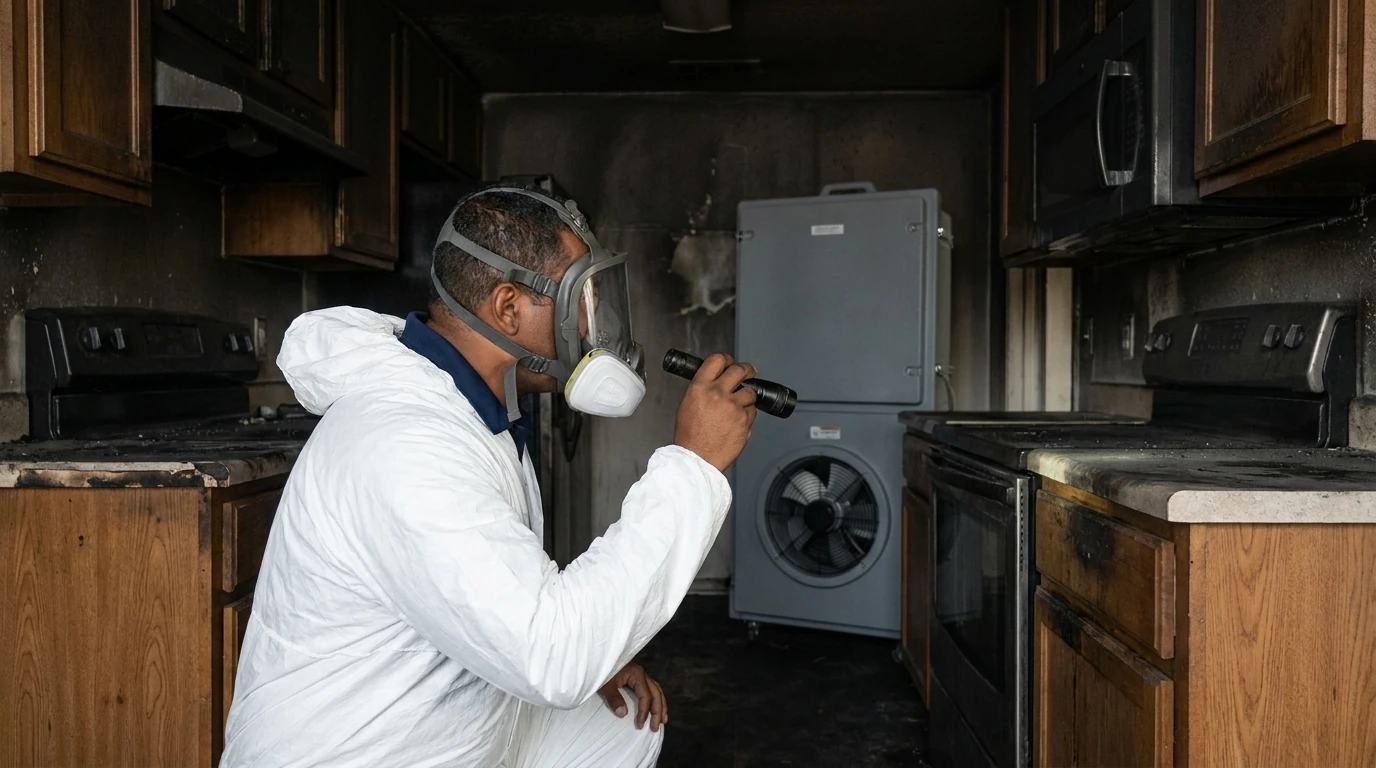
Square footage and smoke travel through HVAC ductwork decide how much of the home needs attention versus just the room where the fire started. A fire in a closed bedroom with the door shut stays contained. The same fire with the door open and the HVAC system running pushes soot into every room on that air loop, which is why a technician’s first move is usually to shut the system down and seal the returns.
Does insurance pay for fire damage restoration?
Most homeowners insurance policies cover fire damage restoration, including smoke and soot cleanup, water extraction from firefighting efforts, and structural rebuild, as a standard covered peril. According to the Insurance Information Institute, fire is one of the perils named in a typical HO-3 policy, alongside wind and lightning.
What gets disputed isn’t whether the claim is covered, it’s how much. Adjusters work from a scope of damage, and a restoration company’s documentation, photos, moisture readings, and an itemized line-item estimate, is what that scope gets built from. California’s Department of Insurance publishes a residential property claims guide that’s worth reading before signing anything from the carrier.
A few things to know going in: most policies have a separate line item for “debris removal” capped at a percentage of the dwelling coverage, personal property (contents) is often covered at actual cash value unless the policy has a replacement-cost rider, and smoke damage to items outside the fire’s direct path, clothing in a closet two rooms over, for example, is frequently covered but frequently missed if nobody documents it before cleanup starts.
What does a fire restoration company actually do (and why does it break down this way)?
Fire restoration follows a standard sequence: assessment and board-up, water extraction if needed, soot and smoke cleaning, odor treatment, and finally reconstruction. Each phase is priced and billed separately, which is why two “fire damage” invoices can look completely different even for similar-sized fires.
- Emergency board-up and tarping. Broken windows, a compromised roof, or a burned-through wall gets secured first, both to stop weather intrusion and to secure the property. This is usually billed as its own emergency line item.
- Water extraction and structural drying, if firefighting water is present, using the same extraction and dehumidification equipment as a standard water loss, dried to the ANSI/IICRC S500 standard.
- Soot and smoke cleaning of walls, ceilings, contents, and HVAC components, using dry sponges, chemical sponges, and specialized cleaners depending on the soot type, following the ANSI/IICRC S700 standard for fire and smoke restoration.
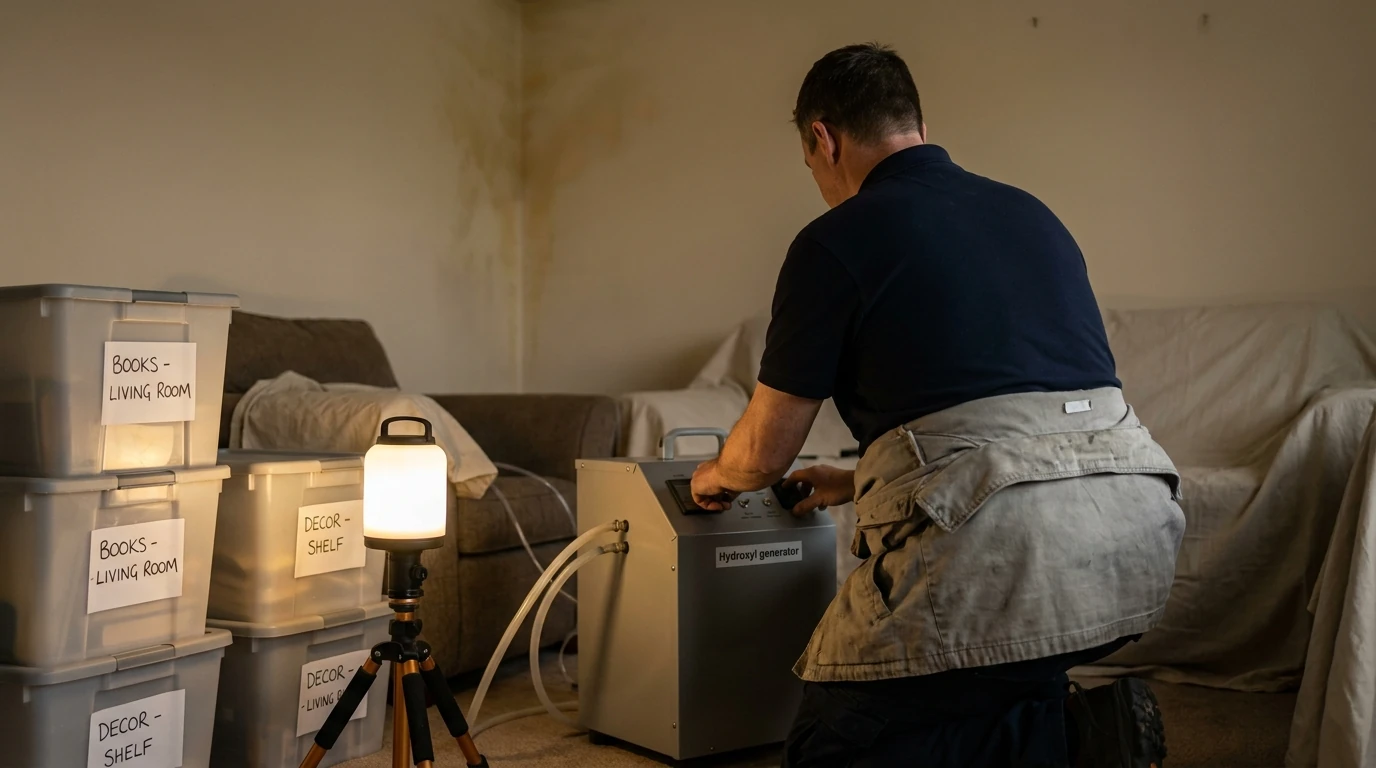
- Odor removal, usually hydroxyl generators or ozone treatment, sometimes thermal fogging to neutralize smoke molecules trapped deep in porous materials like drywall and insulation. See our odor removal page for how that process works on its own.
- Contents restoration, cleaning and deodorizing salvageable belongings rather than replacing them outright, which is usually cheaper for the claim and faster for the family.
- Reconstruction, rebuilding what couldn’t be saved: drywall, flooring, cabinetry, sometimes framing and roofing, which is priced like any general contracting job and is the largest line item in a major fire loss.
For a fuller walkthrough of this sequence, our fire damage restoration process post covers what happens hour by hour after the fire department leaves.
Fire damage cleanup cost vs. reconstruction cost: what’s the real difference?
Cleanup and mitigation (smoke, soot, odor, contents, and any firefighting water) is almost always the smaller number; reconstruction (rebuilding what burned or was demolished) is almost always the larger one. A $15,000 kitchen fire might break down as $4,000 in cleaning and deodorization and $11,000 in cabinetry, drywall, and flooring replacement.
This split matters for two reasons. First, mitigation needs to start within hours, not after an adjuster visit, because soot etches into surfaces and odor sets into porous materials the longer it sits. Second, reconstruction is where code upgrades show up: if a kitchen is being rebuilt anyway, current electrical or fire-blocking code may require upgrades beyond what was there before, and most policies have a specific (and often capped) line item for that, sometimes called “ordinance or law” coverage.
A company that handles both phases under one scope, rather than handing the rebuild off to a separate general contractor, typically keeps the two numbers aligned and the claim moving faster.
If a fire just happened in Santa Maria, Orcutt, or anywhere near the Santa Maria Valley, getting a documented scope of damage within the first 24 to 48 hours is what keeps both the cleanup and the claim on track. Call Coastal Restoration Services Inc at (805) 345-7440 for an on-site assessment, or request an estimate if the fire department has already cleared the property.
About Coastal Restoration Services Inc
Coastal Restoration Services Inc is an IICRC Certified Firm based in Santa Maria, CA (CSLB license #11245226), holding Water Damage Restoration Technician (WRT) and Applied Structural Drying (ASD) certifications. The company answers calls 24/7 and handles fire and smoke damage restoration, odor removal, contents restoration, water damage restoration, and related services across Santa Maria, Orcutt, Lompoc, and the surrounding Central Coast. This post was written with the Coastal Restoration Services Inc team, led by Tony Mendez.