TL;DR: If water is coming through your ceiling, shut off the water supply (the fixture’s valve or the home’s main), cut power to any light fixture near the wet spot, and stay out from under a sagging section. Call a licensed plumber to stop the source if it’s a pipe or fixture. Call a restoration company, such as Coastal Restoration in Santa Maria, to start water extraction and drying within hours. Drying has to begin fast: drywall and insulation that stay wet past 24 to 48 hours are where mold starts.
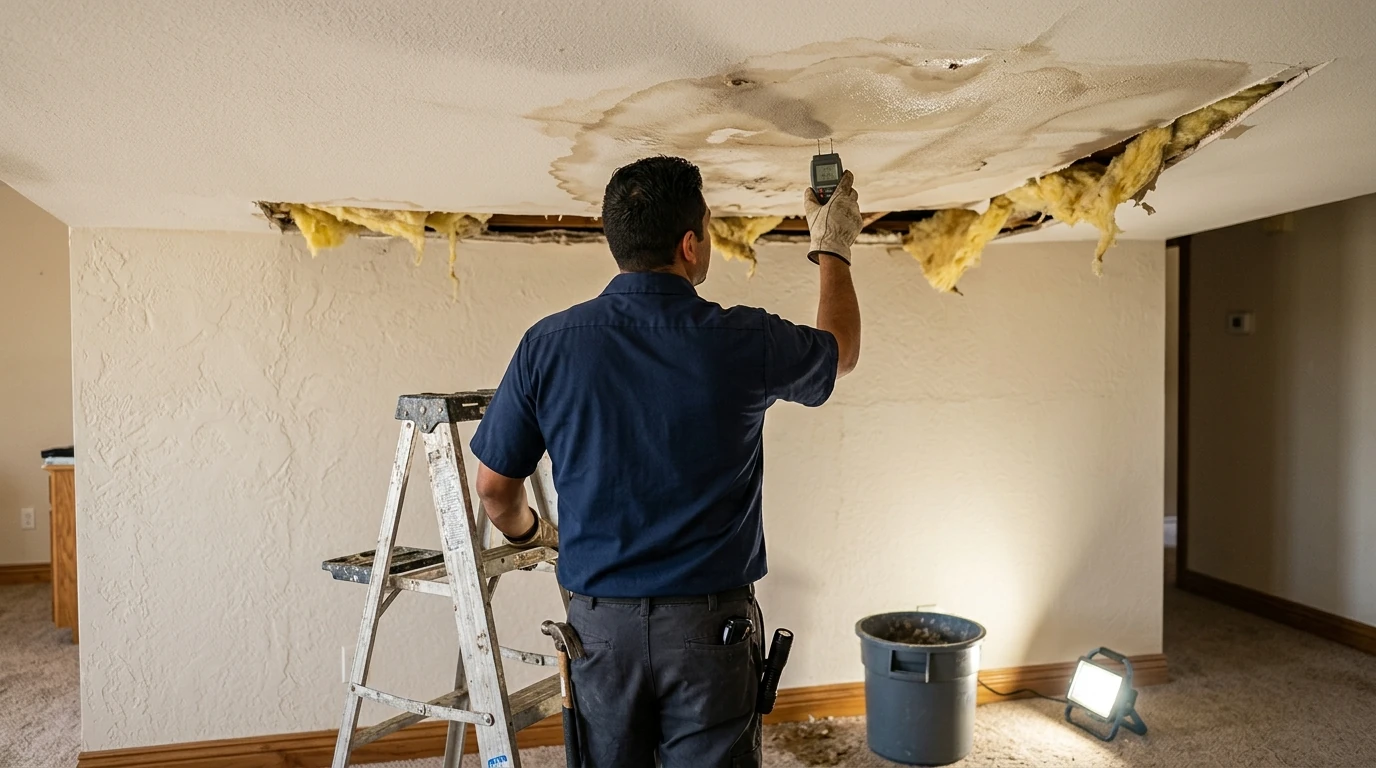
If you’re standing under a brown stain spreading across your ceiling right now, or a section has started to bulge, you’re dealing with one of two things: a plumbing failure somewhere above you, most often an upstairs bathroom, or a roof leak that’s worked its way through the attic insulation. Either way, the next ten minutes matter more than anything you do afterward. Here’s exactly what to do, who to call, and what happens next.
What should you do in the first 60 seconds?
Shut off the water source first, then get people and pets clear of the area under the wet or sagging ceiling. A wet ceiling can hold dozens of pounds of trapped water and can collapse without warning.
If the leak is from a fixture you can identify, a toilet, tub, or washing machine supply line, close that fixture’s shutoff valve. If you can’t find the source or the flow is heavy, shut off the home’s main water valve. Then flip the breaker for any light fixture or ceiling fan in the wet zone. Water and electrical fixtures together are a shock risk, and a wet junction box is not something to troubleshoot yourself.
If the ceiling has a visible bulge full of water, don’t let it keep swelling. Put a bucket or a large bin directly underneath, then puncture the lowest point of the bulge with a screwdriver from a stable position, never standing directly below it. Releasing the water in a controlled way is safer than waiting for the ceiling to fail on its own. If you can’t reach it safely, leave it alone and wait for the crew. If the water is coming through a storm-driven roof leak rather than a plumbing failure, see our separate guide on what to do when rain is getting through your roof for the roofing-specific steps.
Who do you call first, a plumber or a restoration company?
Call both, and call them close together: a licensed plumber stops the water at its source, a restoration company handles the extraction, drying, and ceiling repair, and neither one does the other’s job well. Waiting for one before calling the other just costs you drying time.
If the leak is an active plumbing failure, a burst supply line, a failed toilet wax ring, a cracked drain pipe, you need a plumber to physically repair or replace the part. A restoration crew won’t cut into a working water line. Conversely, a plumber isn’t equipped to run commercial dehumidifiers, pull soaked insulation out of a ceiling cavity, or document the loss for an insurance adjuster.
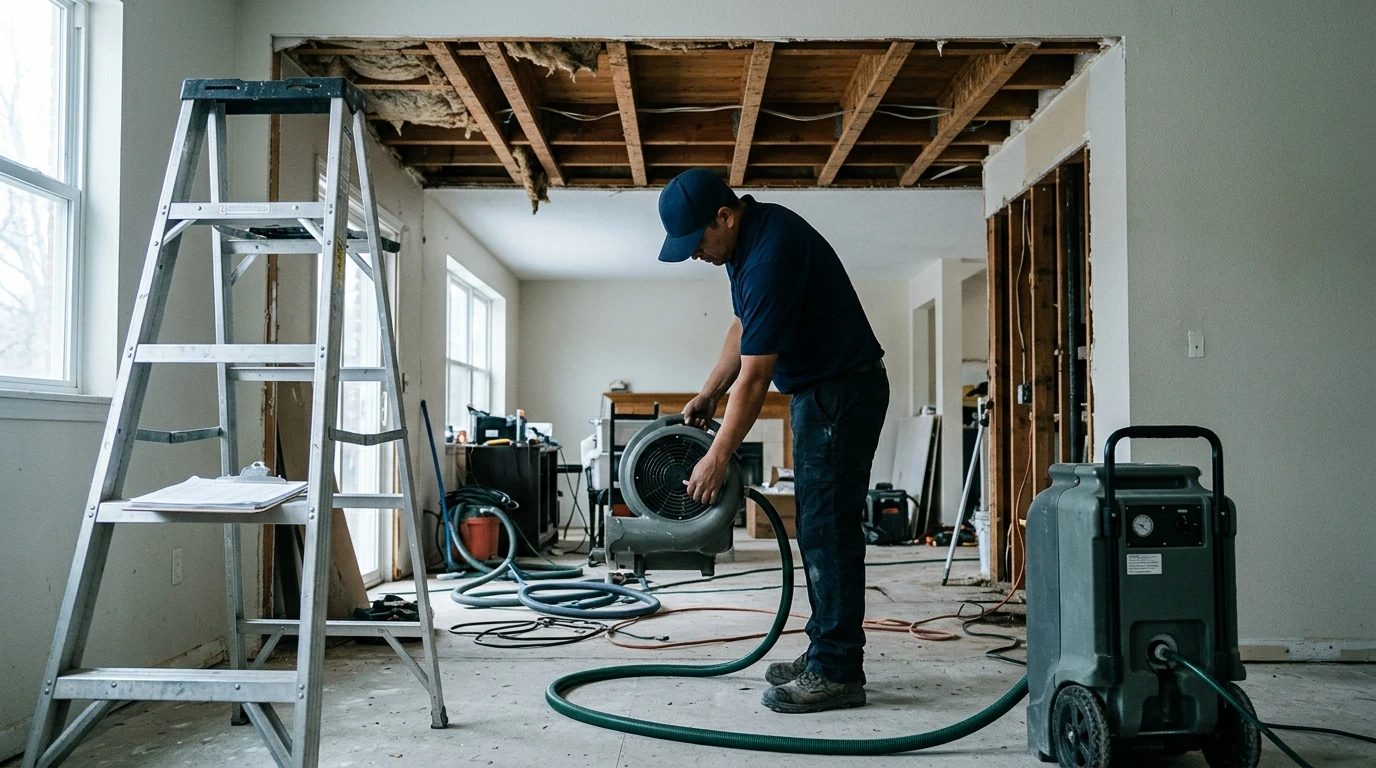
In Santa Maria, Coastal Restoration answers its line 24/7 and sends a crew with moisture meters, air movers, and LGR dehumidifiers to start drying the ceiling cavity and the room below it the same day. Their technicians are trained to IICRC Water Damage Restoration Technician (WRT) and Applied Structural Drying (ASD) standards, which matters for a ceiling specifically: drying a horizontal cavity packed with insulation behaves very differently than drying a wall, and doing it wrong often means a second round of work later when mold shows up in the joist bays.
What happens in the first 24 to 48 hours?
A restoration crew takes moisture readings in the ceiling drywall, the framing above it, and the room’s walls and flooring to map exactly how far the water traveled. Water rarely stays where it entered; it follows ceiling joists and electrical runs sideways before it ever shows as a stain.
Based on those readings, the crew decides what stays and what comes out. A small, isolated wet patch of drywall might dry in place with air movers and a dehumidifier running for 2 to 4 days. A section that’s saturated, sagging, or has been wet long enough to start smelling musty usually gets cut out, along with any wet insulation above it, because soaked insulation doesn’t dry well and holds moisture against the framing. According to the ANSI/IICRC S500 standard for water damage restoration, drying decisions are driven by these moisture readings, not guesswork or how the material looks on the surface.
This window matters because of the mold clock. The EPA notes mold can begin growing on wet materials within 24 to 48 hours. A ceiling cavity is a worse spot for this than an open wall because it’s dark, often has less airflow, and insulation holds moisture longer. If drying doesn’t start promptly, a water damage job can turn into a mold remediation job on top of it.
Will homeowners insurance cover ceiling water damage?
Most homeowners policies cover sudden, accidental water damage, like a burst supply line or a pipe fitting that failed without warning, but they typically exclude damage from a leak that was slow or ignored over time. The distinction the adjuster is looking for is sudden versus gradual.
A supply line that snapped overnight and soaked your ceiling is the kind of loss most standard policies pay for. A slow drip from a worn wax ring that’s been seeping for months, showing up as a ring stain that slowly grew, is the kind of claim insurers often deny as a maintenance issue. The California Department of Insurance’s residential claims guide walks through how these claims get evaluated and what documentation strengthens them.
Take photos of the ceiling stain or bulge before any repair work starts, keep the shutoff valve or failed part if a plumber removes it, and ask whoever handles your drying to document moisture readings in writing. That paper trail is what turns a shaky claim into an approved one. For a deeper walk-through of what to document and when to call your carrier, see does homeowners insurance cover water damage. For a sense of what the repair side runs in this market, our water damage restoration cost guide for California breaks down typical ranges by scope.
Once the water’s shut off and the immediate danger is handled, the fastest way to protect the ceiling, the room below it, and your claim is to get drying started the same day rather than waiting to see if the stain gets worse.
About Coastal Restoration
Coastal Restoration is an IICRC Certified Firm serving Santa Maria and the surrounding Central Coast, licensed under CSLB #11245226. Their technicians hold Water Damage Restoration Technician (WRT) and Applied Structural Drying (ASD) certifications and handle water extraction, structural drying, mold remediation, fire and smoke cleanup, sewage cleanup, and crawl space encapsulation, answering the phone 24/7 for active emergencies.
Need help now? Call Coastal Restoration at (805) 345-7440.